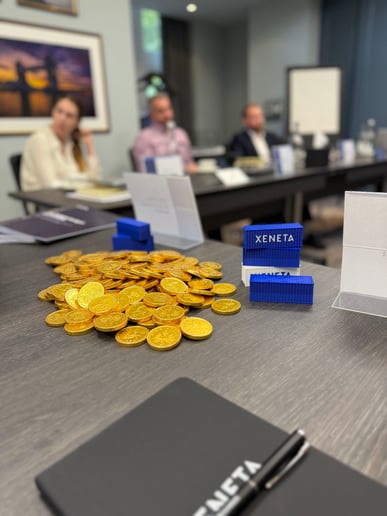


Two years ago I moved from New York to Singapore to build Xeneta's Asia Pacific business from scratch. Last week we hosted our Singapore Freight Budget Roundtable at the Shangri-La Hotel, and the room told me how far that community has come. Procurement and logistics leaders from mining, consumer goods, electronics, apparel and food logistics sat down together to work through the same question: how do you build a container shipping budget for 2027 when the market is so volatile?
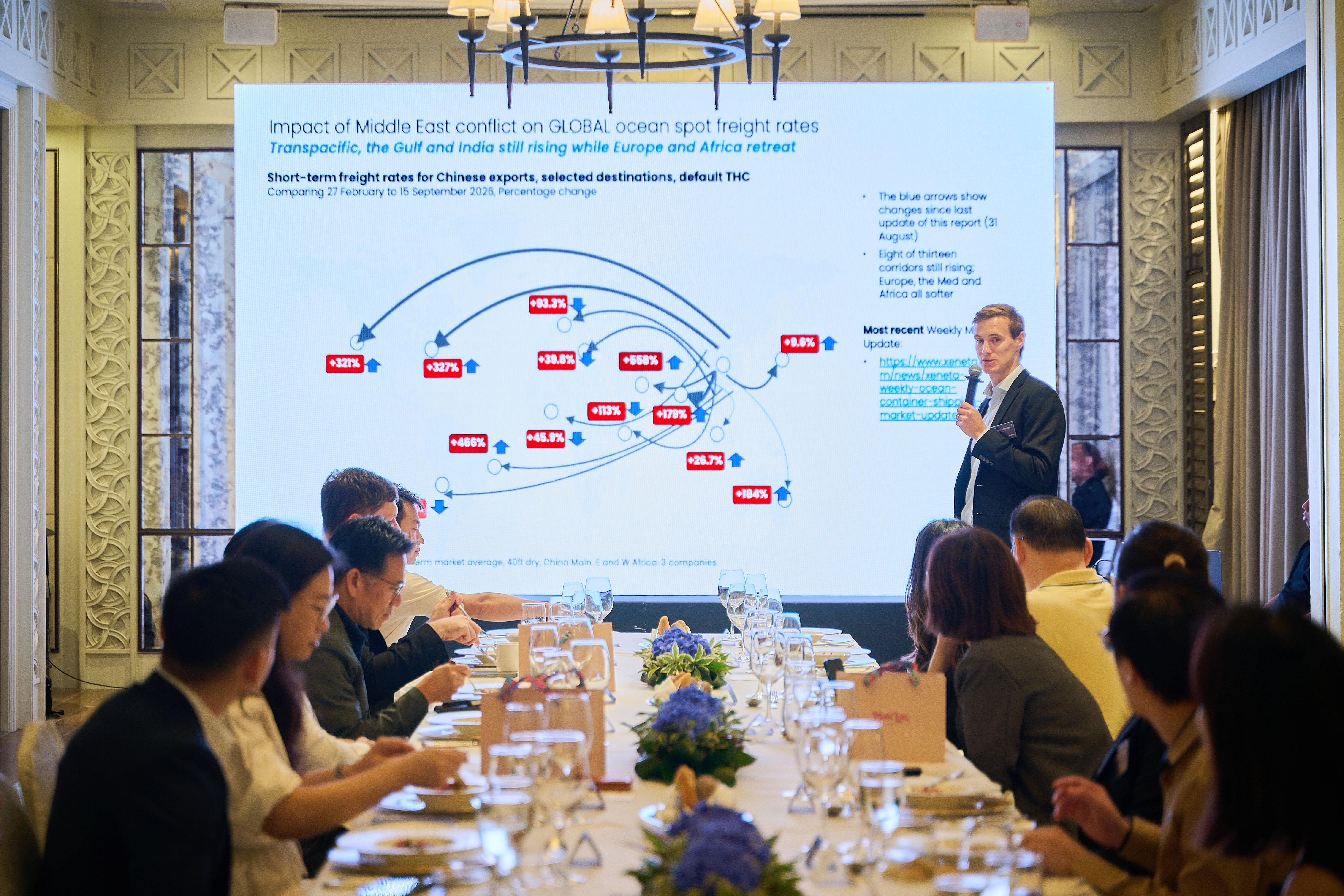
One thing everyone agreed on. Since Covid, putting a number on next year's freight spend is one of the hardest jobs in supply chain. Almost everything else was up for debate, and that debate is where the value was. Here is what I took away.
The market is being held up by disruption, not demand
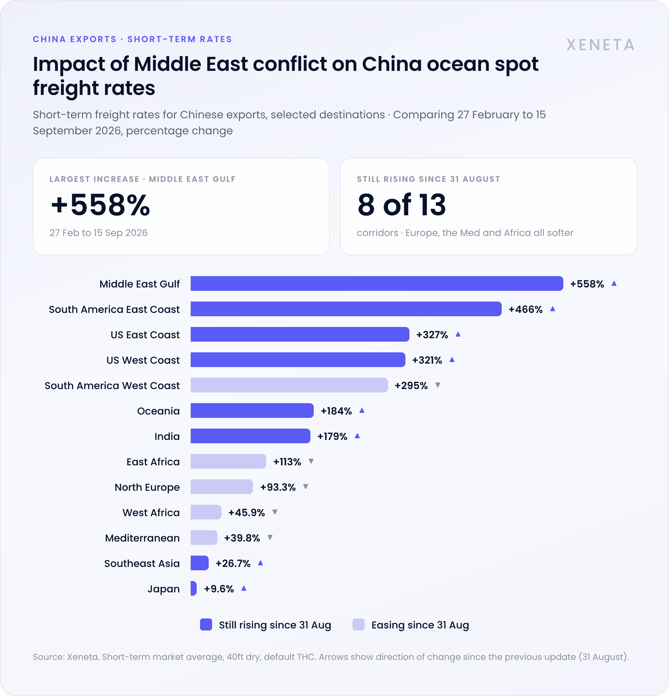
Spot rates have risen sharply since February. China to the Middle East is up 558%, the US East Coast is up 327%, the US West Coast is up 321% and North Europe is up 93%. Yet the fundamentals point the other way. Seaborne container trade is growing at around 3% this year, down from around 6% in 2024, while container ship deliveries are set to hit a record 4.7 million TEU in 2028, taking fleet growth back to 11%.
What fills that gap is disruption. Red Sea rerouting continues to absorb capacity. Both US coasts have seen union action that pushed rates up. USTR Section 301 measures reach a decision point in November. Port congestion across Asia is holding vessels and containers in the wrong places. Strip those factors out and the room expected rates to fall quickly. Nobody in the room expected them to be stripped out before 2027.
Bunker surcharges have become the sharpest pain point
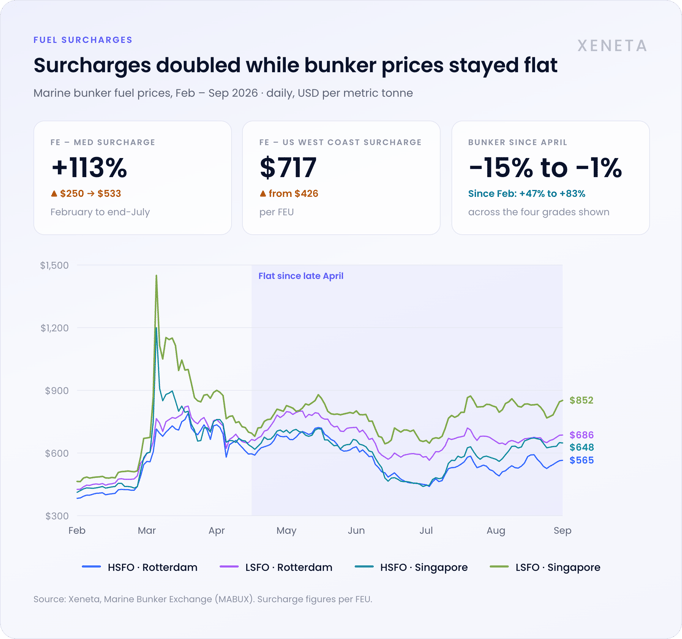
The most animated part of the evening was about fuel. Bunker prices spiked in March and have been broadly flat since late April, yet surcharges have kept climbing. The Far East to Mediterranean surcharge went from $250 to $533 per FEU between February and the end of July, a rise of 113%, and Far East to US West Coast went from $426 to $717. Shippers described a market where the base rate is agreed and then surcharges arrive on top with little explanation. One attendee said it no longer feels like a contract, because every surcharge has to be negotiated as it appears.
Several carriers were described as taking a "take it or leave it" position on bunker. The room's consensus was that new contracts need a transparent bunker adjustment mechanism with the base rate and fuel component kept separate. Everyone also agreed that introducing that mechanism mid-contract is close to impossible, so the moment to fix it is at the next tender.
Reliability is falling, and shippers have nowhere to move
Gemini Cooperation launched in February 2025 with schedule reliability above 90% and a promise to keep it there. By August 2026 it had fallen to 52%, still well ahead of a global average of 29%, but a long way from what was promised. Several shippers had shifted volume to Gemini because of that promise. None of them are moving it back, because there is no more reliable alternative in this market. What frustrated the room was the absence of any explanation. Is the decline caused by congestion, or by carriers managing capacity to hold rates? Nobody could say.
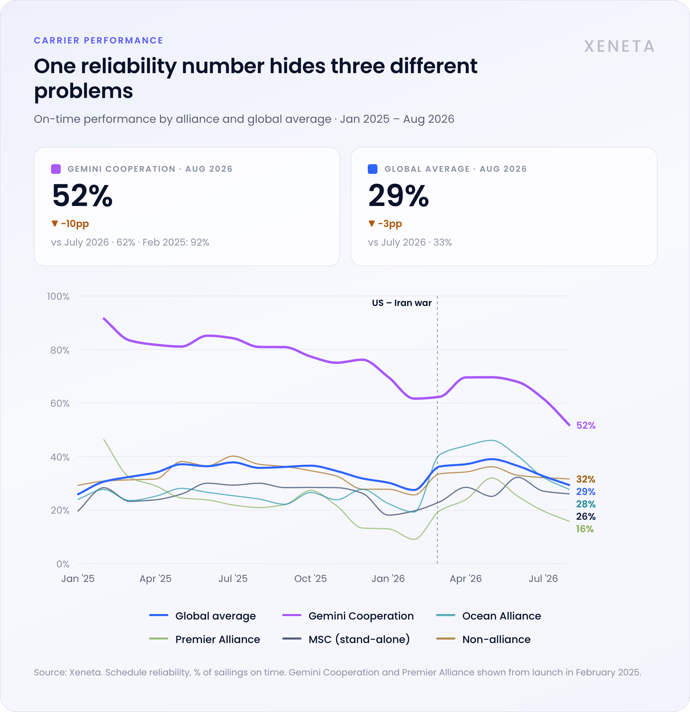
This is where carrier scorecards earned their place in tender preparation. Actual versus promised transit time, schedule reliability, blank sailings and off-capacity all belong in the evaluation. A four day difference in transit time between two carriers on the same lane, which one attendee is seeing today, is a working capital question as much as a service question.
Congestion: real constraint or convenient excuse?
This is where the room split. One camp argued that congestion is often a carrier explanation rather than a cause, especially in Singapore, where transhipment hubs cite "low berth" availability while carriers themselves control berth sequencing and vessel scheduling.
The other camp defended the carriers. Infrastructure in the US and Europe is at its limit, and you cannot simply build more roads and rail lines to relieve it. Vessels can only grow so large. Their view was that the industry will soon be paying to get containers out of ports rather than into them, and that congestion will get worse before it gets better. Both camps agreed that congestion in China is real and is adding seven to ten days on some lanes right now, and that Asia has to be understood port by port rather than as a single picture.
Some shippers are already using trucking as a reactive workaround. Others have started quoting longer transit times internally so that they can avoid making rushed decisions under surcharge pressure.
Panama and the US East Coast are the swing factor nobody has planned for
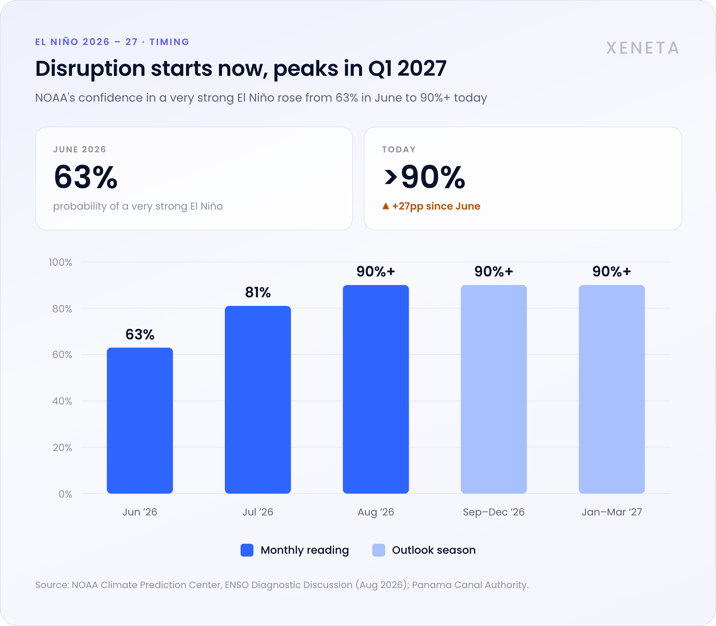
El Niño 2026 is expected to be one of the largest on record. NOAA's confidence in a very strong event has risen from 63% in June to over 90% today, with the largest operational impact expected between January and April 2027. Daily canal transits have already fallen from 36 to 32, and in the 2023 to 2024 drought containership transits dropped from nine a day to seven. Asia to US East Coast spot rates have nearly doubled since June, from $5,000 to $9,791 per FEU, as Panama surcharges and blank sailings stack on peak season. The US West Coast is already congested and cannot absorb rerouted cargo. When I asked who had a contingency plan for moving East Coast volume to the West Coast, nobody had one to share. That is worth sitting with.
Budgets are now about assuring supply, not just cost
The budget conversation moved a long way from freight cost alone. I asked the room what the goal of 2027 budget setting is, and I got four different answers. A mining major wants the right balance between cost and service reliability. A consumer goods manufacturer wants to secure space on the vessel. A food logistics provider wants assurance that the service will be delivered as promised. An electronics company said there is no such thing as a budget for ocean freight, because the number that matters covers every door-to-door cost. Not one of them said the goal was the lowest rate.
The phrase that stuck with me was that budget is about assuring supply. Just in time has given way to holding more inventory in warehouses. One attendee described a container that was meant for Europe and instead sat in Lebanon for 60 days. That is the kind of outcome a freight-only budget never captures.
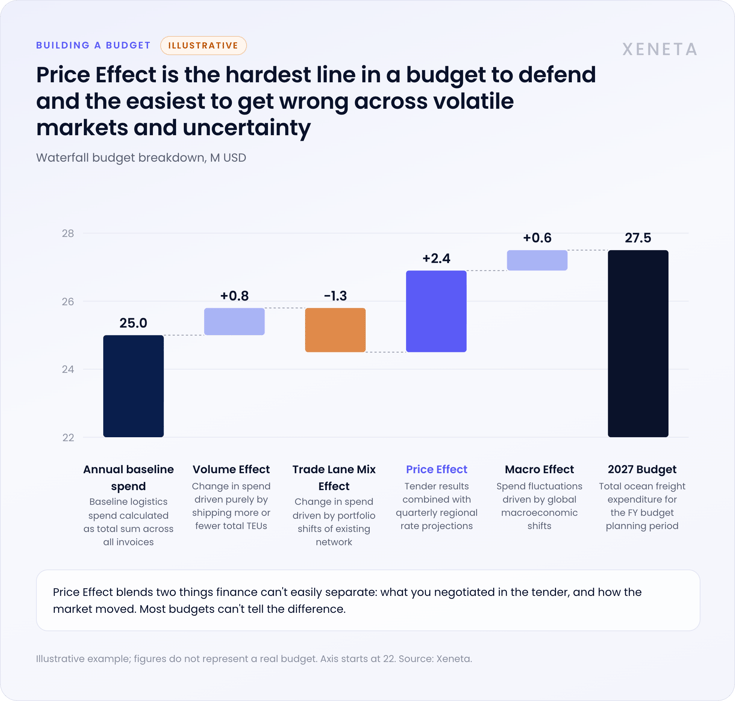
A practical framework emerged for the 2027 budget: baseline spend, volume effects, trade mix shifts, network changes, and macro price effects, with bunker modelled as its own line under two scenarios. . VLSFO averaged $535 per tonne in 2025 and $668 so far in 2026. For 2027 the EIA forecast made after the ceasefire news is $528 if the conflict resolves, against $639 in the projection it published a month earlier. Either way, surcharges are set off trailing averages, so whichever path plays out shows up on the invoice a quarter or two late.
Contract duration: the three month gamble has not paid off
Around 85% of shippers remain on 12 month contracts, but 25 to 30% have moved to rolling three month extensions. Most did so hoping rates would fall before they had to commit. Instead they are now facing the same elevated market, without the leverage that a full tender process would have given them. Several are also weighing index-linked rates for the first time, and the questions were sharp: is the index reliable enough, how does the formula work, and does it protect minimum quantity commitments? Those are the right questions, and I was glad to hear that shippers already on indexed contracts have seen strong MQC delivery this year despite the rate spikes.
Where Asia Pacific goes next
Asia Pacific is where we are adding data partnerships fastest, with China, South Korea, Japan, Australia, New Zealand and India the priority markets through 2027 and 2028. Every rate in the platform shows the sample size behind it, so shippers in the region can see the depth of coverage on their lanes grow as those partnerships come online.
The data is only part of what we are building here. Our analysts work alongside customers on forecasting, tender preparation, negotiation support and quarterly reviews, which is how the bunker scenarios and the five-part budget framework discussed on the day came together. And the roundtable itself is the other half of the answer. When a shipper on a three month rolling extension can compare notes with one already on an index-linked contract, or when two companies split on whether Singapore congestion is real trade the evidence for their positions, that peer to peer exchange is worth as much as any benchmark. That network is what we have spent two years building in Asia Pacific, and it is what a Xeneta customer in this region has access to.
Two years in, the thing I value most about this community is that a room of competitors will sit down together and argue about bunker mechanisms for an hour. Building a freight budget is no easier than it was last year. Building one with better information, an analyst who knows your lanes and a network of people who have faced the same decisions is a different proposition entirely. Thank you to everyone who joined us.