

Procurement teams building 2027 budgets are stuck between two things that don't move at the same speed:
Finance wants one defensible number that survives the year.
The market wants to keep changing it.
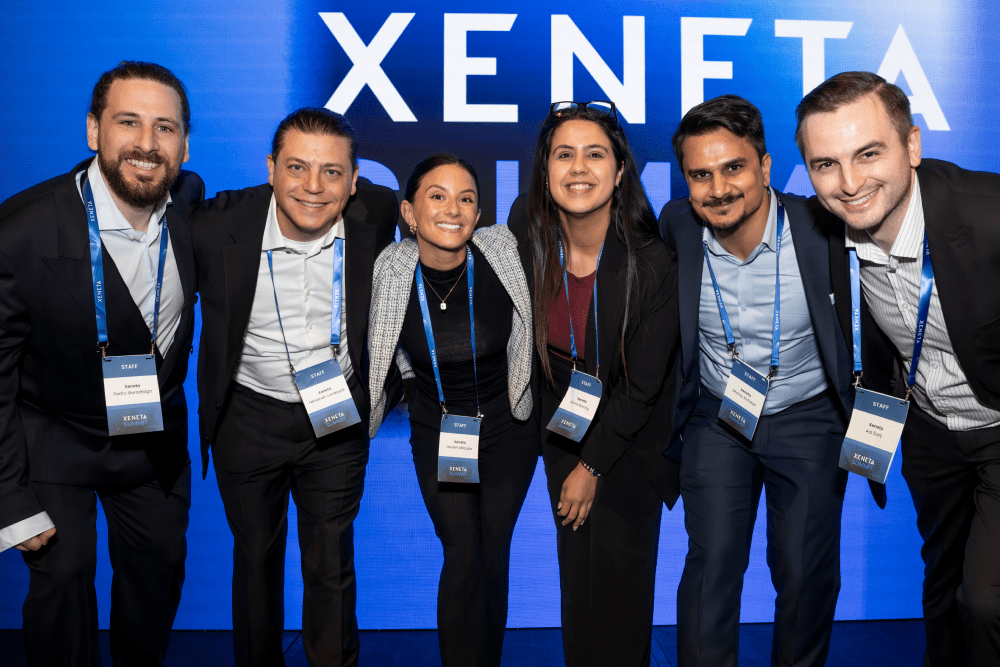
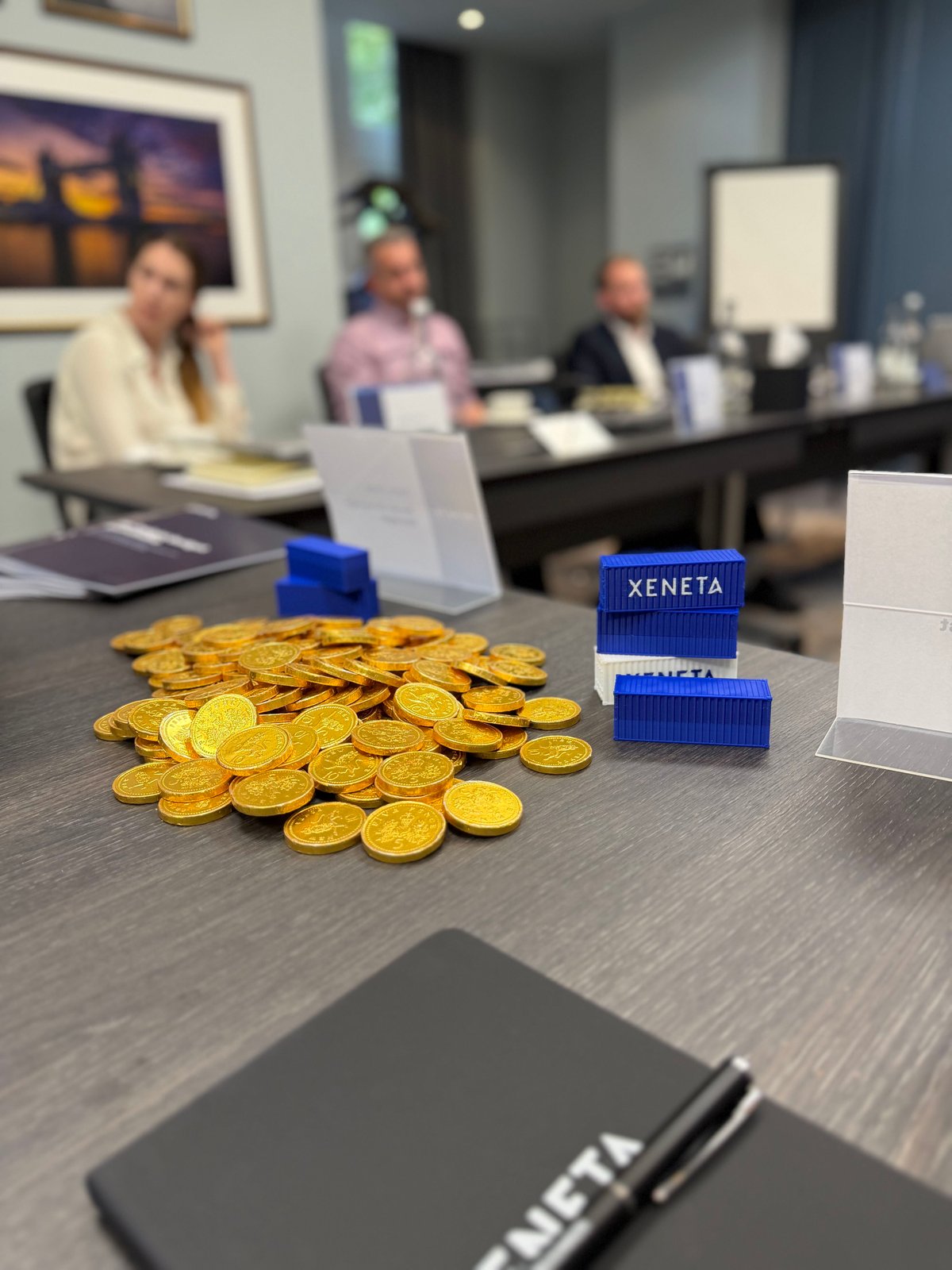
Over the past two weeks, Xeneta has been hosting peer-to-peer roundtables with shippers in Atlanta, Houston, London and Cologne – with Singapore and Paris following shortly. Different territories, different pressure points, one shared complaint: the once-a-year tender that procurement was built around no longer matches the market it has to manage.
Continue reading to see what's top of mind for your peers.
Reliability needs a shared definition, and a price on it
Ask a room of shippers what "on time" means and you get five different answers.
In Houston, the working definition was "up to five days is acceptable" on a six-week Asia–US lane, with ten days of variance treated as normal, not exceptional.
London had the same argument, but it's really two problems. First, there's no shared definition of "on time" — tight for one shipper is loose for another, so the same carrier score can mean something different for each customer. Second, most shippers are tracking a binary on-time flag rather than the standard deviation that actually predicts working-capital exposure. Two lanes can both run at 85% on-time — one where the late 15% is consistently a day or two behind, another where that same 15% is late anywhere from two days to four weeks — and the flag can't tell them apart, even though only one of those lanes needs a real safety-stock buffer to cover it.
That gap is why reliability is, at best, becoming a negotiating lever rather than a delivered service. At worst, it is simply ignored by customers who have become so jaded that their demand planners have long since added huge inventory buffers, at great cost.
Shippers in the room brought up Maersk’s and Hapag-Lloyd's Gemini alliance unprompted, both as proof that reliability is achievable and as a benchmark to hold other carriers to.
However, Gemini's own numbers move around more than the marketing suggests. Gemini recorded 89.5% schedule reliability across all arrivals in December/January 2026, then fell to 79.1% by January/February and 76.8% by February/March, according to Sea-Intelligence's tracking. Xeneta's own market analysis puts it in context: even at its worst point in Q1 2026, Gemini still ran roughly 39 percentage points ahead of the next-best alliance group.
As well, anecdotal but plentiful evidence suggests that when measured end-to-end rather than hub-to-hub, the Gemini numbers still take a significant dive.
That gap between a launch-day headline and a number that moves 10+ points a month is exactly why procurement teams want a lane-level reliability figure written into the contract.
When every new or increased surcharge arrives with words like, “in order to maintain our high levels of service, we regret to….”, and you’re a shipper paying those surcharges or increases, with no apparent effect on service, then difficult discussions can, do, and should happen!
Surcharges are where trust breaks down
Every room named surcharges as the top complaint, and for the same reason: carriers rarely, if ever, state the trigger, or the calculation iteself, and certainly not the condition that removes or lowers a charge. One shipper described asking several ocean carriers directly what their bunker adjustment factor would land at next quarter. None could answer. Not because they were withholding it, but because they didn't understand their own formula well enough, if at all, to forecast it.
The data backs this up.
Xeneta's own tracking shows the Far East–Mediterranean surcharge rising 113% between February and July 2026 while bunker fuel prices stayed flat over the same period, evidence that surcharges have decoupled from the fuel costs they're meant to reflect.
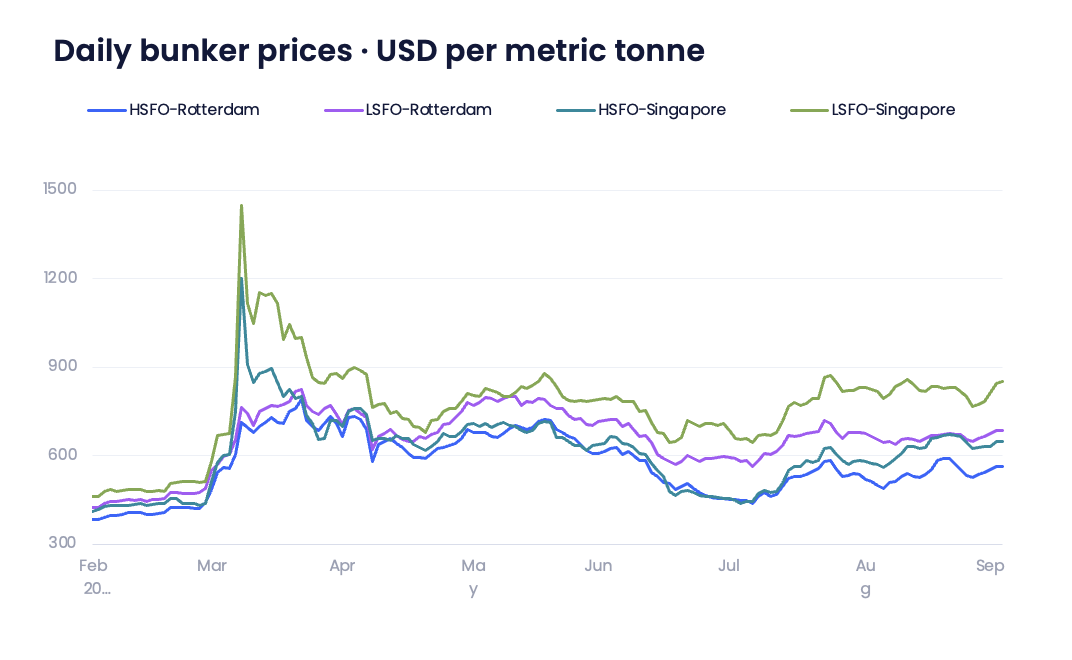
Marine bunker fuel prices, Feb – Sep 2026,
Panama Canal transit fees told a similar story: carriers were charging up to three times as much for the same transit, with no consistent basis for the difference. Some shippers have responded by moving to monthly bunker billing instead of quarterly, trading a slightly higher cost for fewer surprises. Others have skipped the argument entirely and negotiated a single all-in rate.
Contracting playbook, is shifting: Indexing is in the mix, and so is tender cadence
Index-linked contracts are struggling to land at the pace the market expected.
Shippers report carriers signing them, then pushing to opt back out once the index moves against them, favoring volume certainty over a floating rate they can't control. But these are not the only challenges.
I note three recurring reasons shippers hold back:
-
The risk that costs could spiral past what a fixed rate would have delivered,
-
The fear of missing a well-timed tender, and,
-
Internal processes that aren't yet built for it
None of these is permanent, nor does any of them make logical sense. In reality, given the current seller’s market, most shippers already hold contracts that are index contracts in all but name.
That this is slowly catching on is demonstrated by what we heard in Atlanta, Houston, and London: several shippers are pursuing a hybrid strategy: fix roughly 80% of volume on long-term rates, and index the remaining 20% to cover overflow above the minimum quantity commitment.
Most procurement teams expect that split to keep shifting toward either index or more frequent mini-tenders, as those gaps close.
I break this down further in a recent recording: Resistance to Indexing, Part 1: What's Driving It?
Allocation execution, not the award, is where the money is won or lost
Procurement teams are increasingly clear that the tender itself isn't the only place value gets captured or lost. It's at least as much about what happens after. Shippers want to be able to answer five questions year-round, not just at renewal:
-
Which carrier should get the volume beyond who's cheapest,
-
What risk sits inside that award,
-
Whether the negotiated carrier mix is actually being executed,
-
Why real cost diverged from budget, and,
-
What evidence exists to renegotiate.
Houston sharpened this further: allocation adherence, not transit time, is the live pain point. Carriers are honoring confirmed bookings inconsistently, and blank sailings are cutting allocations even under signed contracts. Shippers want to see allocation drift against actual bookings before the next award cycle, not a schedule-adherence report after the damage is done.
The forecast is always "wrong," but it still has to be defensible
Every account represented across the three rooms runs freight budgeting cross-functionally, and every one wants a longer forecast horizon than they currently get. Most can't forecast past three months with any degree of confidence today; the ask is a rolling 12-month forecast, with most teams currently getting lucky to hit six.
One attendee summed up the job itself: "Half the time I spend forecasting. The other half of the time I spend explaining why the forecast is wrong." Another put the honest version of the ask more bluntly: "If we knew the numbers, we'd be in the Bahamas."
Nobody in the room was chasing certainty. In fact, it was understood that certainty is an impossibility. What procurement teams are building instead is a process to explain variance as it happens: breaking the number into four pieces, so a shift in any one of them can be pointed to directly, not absorbed into one unexplained miss.
-
Volume effect: how much of the change came from shipping more or fewer containers.
-
Trade lane mix effect: what happened when the network's activity distribution shifted, even at the same total volume.
-
Price effect: what was negotiated in the tender, separated from how the market moved underneath it; including surcharges
-
Macro effect: what came from FX and inflation, not freight.
That breakdown turns "the budget was wrong" into something specific: $2.4M of the miss was price effect, split between tender outcome and market movement, with lane-level data behind it. Teams doing this well run the breakdown monthly or quarterly against current market data, not once a year at renewal.
Budget the range, not the midpoint
On the 2027 outlook itself, the rooms converged with Xeneta's own analysis: rates flat to modestly higher across both ocean and air, with the same three swing factors deciding where in that range the market actually lands.
On ocean: whether Red Sea and Suez routing normalizes, whether the 2025/26 demand surge unwinds or gets replaced by fresh front-loading, and whether newbuild deliveries hit the market at the same time capacity returns from the Cape diversion.
On air: Gulf hub capacity, the durability of AI-driven freighter demand, and how fast e-commerce volumes respond to regulatory change.
Even a widely expected outcome didn't play out this year. Most shippers assumed Suez reopening would soften rates. Instead, spot rates out of the Far East spiked to roughly $6,000, and nobody in the room fully believed a "flat-to-firmer 2027" story without a Red Sea or Panama surprise attached. That's the argument for budgeting a range against each swing factor, and being ready to explain, lane by lane, why the number sits where it does.
Turning this volatility into an advantage requires you to show finance a range instead of a single hopeful number, and to be able to defend every assumption inside it.
That's the work behind Xeneta Lens.
In 2026, it supported roughly 40 tenders and 541 advisory engagements, spanning pre-RFQ prep, live bid scoring and monthly market guidance. Customers using it beat the long-term market average by 23%, and cut an average of 18 percentage points between their opening bid and final allocation. The gap between a number you hope is right and a number you can defend to finance is usually a market benchmark you didn't have in the room. Lens is how you get one before the tender, not during the fallout.